Knitted

Cabled Baby Hats

21 March 2011

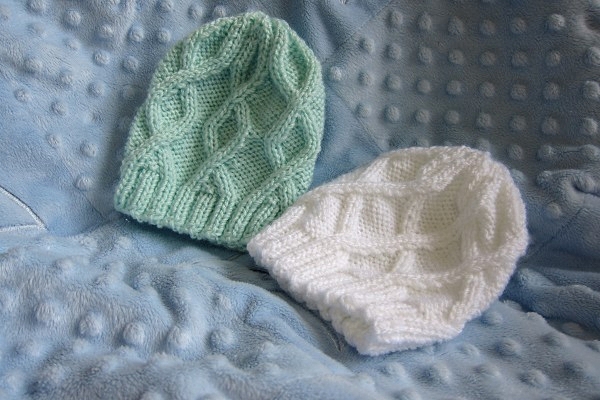
Both of these hats begin with the same ribbing. Hat I is a more simple pattern since the cabling is contained in the repeat area. I would recommend having experience with both knitting in the round and with cabling before attempting Hat II. Because the cabling is across the entire hat, on some rows stitches will need to be shifted between needles to accommodate cable stitches.

Sizes:
Preemie – 10″ circumference
Newborn – 12″ circumference

Gauge:
22 stitches and 30 rows = 4 inches in stockinette

Materials:
0.5 to 0.6 oz (40 to 50 yards) of DK weight baby yarn
Size 6 (4 mm) 40″ circular needle (for magic loopor set of size 6 (4 mm) double pointed needles
Cable needle
Yarn needle

Abbreviations:
k = knit
p = purl
t3f = twist 3 front – Slip the next 2 stitches onto cable needle and hold in front of work. Purl the next stitch from the left-hand needle, knit the 2 stitches from the cable needle.
t3b = twist 3 back – Slip the next stitch onto cable needle and hold behind work. Knit the next 2 stitchs from left-hand needle, purl the stitch from the cable needle.
c4f = cable 4 front – Slip the next 2 stitches onto cable needle and hold in front of work. Knit the next 2 stitches from left-hand needle, knit the 2 stitches from the cable needle.
k2tog = knit two together
ssk = slip one knitwise, slip one knitwise, insert left needle into front of both slipped stitches and knit.
* = repeat instructions between *’s across the round. Instructions before a * are for the beginning of the round and instructions after a * are for the last stitches of the round.

Cast on and Ribbing:
Cast on 60 for preemie size or 72 for newborn. Join to knit in the round. Divide stitches between double pointed needles or needles for a magic loop. For Hat I, divide with multiples of 12 on each needle.

Ribbing (6 rounds for preemie size, 8 rounds for newborn size: *k2, p2*

Hat I
Rnd 1: *t3f, p4, t3b, p2*
Rnd 2: *p1, k2, p4, k2, p3*
Rnd 3: *p1, t3f, p2, t3b, p3*
Rnd 4: *p2, k2, p2, k2, p4*
Rnd 5: *p2, t3f, t3b, p4*
Rnd 6: *p3, k4, p5*
Rnd 7: *p3, c4f, p5*
Rnd 8: *p3, k4, p5*
Rnd 9: *p2, t3b, t3f, p4*
Rnd 10: *p2, k2, p2, k2, p4*
Rnd 11: *p1, t3b, p2, t3f, p3*
Rnd 12: *p1, k2, p4, k2, p3*
Rnd 13: *t3b, p4, t3f, p2*
Rnd 14: *k2, p6, k2, p2*
Rnds 15-28: Repeat Rnds 1-14
Rnd 29: *k1, ssk, p4, k2tog, k1, p2*
Rnd 30: *k2, p4, k2, p2*
Rnd 31: *k1, ssk, p2, k2tog, k1, p2*
Rnd 32: *k2, p2, k2, p2*
Rnd 33: *k1, ssk, k2tog, k1, p2*
Rnd 34: *k4, p2*
Rnd 35: *ssk, k2tog, p2*
Rnd 36: *k2, p2*
Rnd 37: *k2tog, p2tog*
Cut the yarn with several inches to work with. With a yarn needle, pull the yarn through all the remaining loops, secure and weave in end.

Hat II
Rnd 1: *k2, p2, k2, p6*
Rnd 2: *k2, p2, k2, p6*
Rnd 3: *t3f, t3b, p6*
Rnd 4: *p1, k4, p7*
Rnd 5: *p1, c4f, p7*
Rnd 6: *p1, k4, p7*
Rnd 7: *t3b, t3f, p6*
Rnd 8: *k2, p2, k2, p6*
Rnd 9: k2, *p2, t3f, p4, t3b* (last t3b includes k2 from beginning of round)
Rnd 10: p3, *k2, p4*, k1
Rnd 11: k1, *p4, t3f, p2, t3b* (last t3b includes k1 from beginning of round)
Rnd 12: p5, *k2, p2, k2, p6*, k2, p2, k2
Rnd 13: *p6, t3f, t3b*
Rnd 14: *p7, k4, p1*
Rnd 15: *p7, c4f, p1*
Rnd 16: *p7, k4, p1*
Rnd 17: *p6, t3b, t3f*
Rnd 18: *p6, k2, p2, k2*
Rnd 19: p1, *p4, t3b, p2, t3f* (last t3f includes p1 from beginning of round)
Rnd 20: *p4, k2*, p4, k1
Rnd 21: k1, p3, *t3b, p4, t3f, p2*, t3b, p4, t3f (last t3f includes k1, p1 from beginning of round)
Rnd 22: *p2, k2, p6, k2* p2, k2, p6
Rnd 23: *t3f, t3b, p6*
Rnd 24: *p1, k4, p7*
Rnd 25: *p1, c4f, p7*
Rnd 26: *p1, k4, p7*
Rnd 27: *t3b, t3f, p6*
Rnd 28: *k2, p2, k2, p6*
Rnd 29: k2, *p2, K1, ssk, p4, k2tog, k1*, p2, k1, ssk, p4, move first stitch from prior round to end of this round, k2tog. This stitch is now permanently moved.
Rnd 30: *k1, p2, k2, p4, k1*
Rnd 31: *k1, p2, k1, ssk, p2, k2tog*
Rnd 32: *k1, p2, k2, p2, k1*
Rnd 33: *k1, p2, k1, ssk, k2tog*
Rnd 34: *k1, p2, k3*
Rnd 35: k1, *p2, ssk, k2tog*, p2, ssk, move first stitch from prior round to end of this round, k2tog. This stitch is now permanently moved.
Rnd 36: *p2, k2*
Rnd 37: *p2tog, k2tog*
Cut the yarn with several inches to work with. With a yarn needle, pull the yarn through all the remaining loops, secure and weave in end.

Edits:

12/17/2015 – replaced a broken link for Magic Loop method
11/13/2018 – corrected wording of parenthetical on rnd 21.

Basic Baby Hat

21 March 2011

This is a very basic baby hat in several sizes. This is designed for in-the-round knitting.

Sizes:
Preemie – 11″ circumference, 5.5″ high
Newborn – 13″ circumference, 6″ high
12 month – 15.25″ circumference, 7″ high
Toddler – 17.5″ circumference, 7.5″ high
Teen – 19.5″ circumference, 8″ high

Gauge:
22 stitches and 30 rows = 4 inches in stockinette

Materials:
0.5 to 1 oz (40 to 80 yards) of DK weight baby yarn
Size 6 (4 mm) 40″ circular needle (for magic loop) or set of size 6 (4 mm) double pointed needles
Yarn needle

Abbreviations:
k = knit
p = purl
k2tog = knit two together
ssk = slip one knitwise, slip one knitwise, insert left needle into front of both slipped stitches and knit.

Pattern:
Preemie – Cast on 60
Newborn – Cast on 72
12 month – Cast on 84
Toddler – Cast on 96
Teen – Cast on 108

Join to knit in the round. Divide stitches between double pointed needles or needles for a magic loop. Divide with multiples of 12 on each needle.

Ribbing (6 rounds for preemie size, 8 rounds for other sizes): k2, p2 repeated across round

Knit until the hat measures the desired height for size including the ribbing:
Preemie – 4.25″ high
Newborn – 4.75″ high
12 month – 5.75″ high
Toddler – 6.25″ high
Teen – 6.75″ high

Before starting the crown, there are 60 (72, 84, 96, 108) stitches

Crown:
Repeat across the round
Rnd 1: k4, k2tog, ssk, k4 – 50 (60, 70, 80, 90) stitches
Rnd 2: k
Rnd 3: k3, k2tog, ssk, k3 – 40 (48, 56, 64, 72) stitches
Rnd 4: k
Rnd 5: k2, k2tog, ssk, k2 – 30 (36, 42, 48, 54) stitches
Rnd 6: k
Rnd 7: k1, k2tog, ssk, k1 – 20 (24, 28, 32, 36) stitches
Rnd 8: k
Rnd 9: k2tog, ssk – 10 (12, 14, 16, 18) stitches
Cut the yarn with several inches to work with. With a yarn needle, pull the yarn through all the remaining loops, secure and weave in end.

Edits:
11/3/2013 – made adjustments to sizing.
2/19/2014 – added stitch counts to the decreasing rows of the crown.
12/17/2015 – replaced a broken link for Magic Loop method.
1/26/2017 – added “in-the-round” to description.

Boardwalk Ripple Edged Afghan – Worsted

9 March 2011

This is the worsted weight yarn detail page for the Boardwalk Ripple Edged Afghan.  The complete pattern is on this page.

This one repeat sample measures 4.75 inches wide by 5 inches high and was made using worsted weight yarn with size 9 (5.5mm) needles. This is a front and back view.

The following chart gives the number of stitches to cast on for the number of repeats, as well as approximate finished size and yarn requirements.

[grid width=”600″ cols=”150,*,*,*,*”]
Number of Repeats|Cast on|Width in inches|Ounces per half foot in length|Yards per half foot in length~
1|24|4.75|0.36|22.95~
2|48|9.5|0.72|45.9~
3|72|14.25|1.08|68.85~
4|96|19|1.44|91.8~
5|120|23.75|1.8|114.75~
6|144|28.5|2.16|137.7~
7|168|33.25|2.52|160.65~
8|192|38|2.88|183.6~
9|216|42.75|3.24|206.55~
10|240|47.5|3.6|229.5~
[/grid]

The pattern instructions are on this page.

Boardwalk Ripple Edged Afghan – Sport

9 March 2011
Comments Off on Boardwalk Ripple Edged Afghan – Sport

This is the sport weight yarn detail page for the Boardwalk Ripple Edged Afghan.  The complete pattern is on this page.

This one repeat sample measures 3.5 inches wide by 4 inches high and was made using sport weight yarn with size 7 (4.5mm) needles. This is a front and back view.

The following chart gives the number of stitches to cast on for the number of repeats, as well as approximate finished size and yarn requirements.

[grid width=”600″ cols=”150,*,*,*,*”]
Number of Repeats|Cast on|Width in inches|Ounces per half foot in length|Yards per half foot in length~
1|24|3.5|0.15|13.8~
2|48|7|0.3|27.6~
3|72|10.5|0.45|41.4~
4|96|14|0.6|55.2~
5|120|17.5|0.75|69~
6|144|21|0.9|82.8~
7|168|24.5|1.05|96.6~
8|192|28|1.2|110.4~
9|216|31.5|1.35|124.2~
10|240|35|1.5|138~
[/grid]

The pattern instructions are on this page.

Boardwalk Ripple Edged Afghan – Doubled Worsted

9 March 2011
Comments Off on Boardwalk Ripple Edged Afghan – Doubled Worsted

This is the doubled worsted weight yarn detail page for the Boardwalk Ripple Edged Afghan.  The complete pattern is on this page.

This one repeat sample measures 8 inches wide by 8.5 inches high and was made using two strands of worsted weight yarn with size 15 (10mm) needles. This is a front and back view.

The following chart gives the number of stitches to cast on for the number of repeats, as well as approximate finished size and yarn requirements.

[grid width=”600″ cols=”150,*,*,*,*”]
Number of Repeats|Cast on|Width in inches|Ounces per half foot in length|Yards per half foot in length~
1|24|8|0.92|58.65~
2|48|16|1.84|117.3~
3|72|24|2.76|175.95~
4|96|32|3.68|234.6~
5|120|40|4.6|293.25~
6|144|48|5.52|351.9~
7|168|56|6.44|410.55~
8|192|64|7.36|469.2~
9|216|72|8.28|527.85~
10|240|80|9.2|586.5~
[/grid]

The pattern instructions are on this page.

Boardwalk Ripple Edged Afghan – Bulky

9 March 2011

This is the bulky weight yarn detail page for the Boardwalk Ripple Edged Afghan.  The complete pattern is on this page.

One repeat measures 5.75 inches wide and was made using bulky weight yarn with size 10.5 (6.5mm) needles. This is a front and back view.

The following chart gives the number of stitches to cast on for the number of repeats, as well as approximate finished size and yarn requirements.

[grid width=”600″ cols=”150,*,*,*,*”]
Number of Repeats|Cast on|Width in inches|Ounces per half foot in length|Yards per half foot in length~
1|24|5.75|0.53|23.85~
2|48|11.5|1.06|47.7~
3|72|17.25|1.59|71.55~
4|96|23|2.12|95.4~
5|120|28.75|2.65|119.25~
6|144|34.5|3.18|143.1~
7|168|40.25|3.71|166.95~
8|192|46|4.24|190.8~
9|216|51.75|4.77|214.65~
10|240|57.5|5.3|238.5~
[/grid]

The pattern instructions are on this page.

Boardwalk Ripple Edged Afghan

8 March 2011

This pattern is very simple with just a four row repeat, but creates a very dramatic effect.  It also works well for any weight yarn or even doubling yarn for a quick and thick throw.  The horizontal and diagonal lines make it look like a boardwalk, such as Coney Island. The pattern is actually rippled throughout, but it is only really visible on the lower and upper edges.

This is not designed as a reversible pattern, but the back side is attractive enough that a single column of the pattern makes an excellent scarf.  Two or three repeats can make a table runner or shawl.

[grid width=”600″ cols=”*”]
For sample pictures front and back in different yarn weights with guides for finished widths, amounts of yarn and numbers of cast on stitches, see these pages for yarn weight~
sport~
worsted~
bulky~
doubled worsted~
[/grid]

The following chart gives gauge and needle size information for the various yarn weights.

[grid width=”600″ cols=”100,*,100,*,*”]
Yarn Weight|Needle Size – US|Needle Size – Metric|Gauge – stitches in 4 inches|Gauge – rows in 4 inches~
Doubled Worsted|15|10mm|10|12~
Bulky|10.5|6.5mm|13|18~
Worsted|9|5.5mm|16|22~
Sport|7|4.5mm|20|26~
[/grid]

Abbreviations:

k = knit
p = purl
k2tog = knit two together
ssk = slip slip knit: Slip two knit-wise. Insert left needle into front of both slipped stitches and knit.
km1 = knit-make one: Move yarn to back. With left needle pick up thread between last and next stitch inserting front to back. With right needle knit back loop.
pm1 = purl-make one: Move yarn to front. With left needle pick up thread between last and next stitch inserting front to back. With right needle purl back loop.
ws = wrong side

Pattern:

Cast on a multiple of 24 stitches.  The directions for each row should be repeated across the row.

Row 1 (WS): K3, (k1, p1) three times, k6, (p1, k1) three times, k3

Row 2: K3, km1, (p1, k1) twice, p1, k2tog, k4, ssk, (p1, k1) twice, p1, km1, k3

Row 3: K3, (p1, k1) three times, k6, (k1, p1) three times, k3

Row 4: K3, pm1, (k1, p1) twice, k1, k2tog, k4, ssk, (k1, p1) twice, k1, pm1, k3

Row 5: P3, (k1, p1) three times, p6, (p1, k1) three times, p3

Repeat rows 2-5 to desired length. Then do rows 2 through 4 and 1 (cast off on this row).

Top Down Elongated Stitches Baby Hat

26 February 2011

I created this baby hat to coordinate with the crocheted baby blanket Downy-Soft Zig Zags by Carole Prior published in Leisure Arts #2853, Our Best Baby Afghans. It features elongated stitches to mimic the elongated double crochets in the blanket.

This is approximately a twelve month old sized hat.  The hat is 16″ around and 8″ long.

Gauge:
20 stitches and 26 rows = 4 inches in stockinette

Yarn:
Red Heart Designer Sport Yarn
Color A – Latte, .6 oz
Color B – Dutch Blue , .11 oz
Color C – Pistachio, .11 oz

Materials:
Size 7 (4.5mm) 40″ circular or 5 double pointed needles
Stitch marker
Yarn needle

Abbreviations:
inc – Increase: knit and purl in same stitch
k – knit
m – make stitch: with left needle, insert needle from front to back under the yarn between the previous and next stitch; knit into the back loop
kw2w – knit with two wraps: insert right needle to knit, but wrap yarn twice and pull through
kw4w – knit with four wraps: insert right needle to knit, but wrap yarn four times and pull through
dws – drop with slip: slip the stitch with the extra wraps purlwise, dropping the extra wraps. There will be a single elongated stitch.
spw – slip purlwise
* – indicates the sections that should be repeated for the round
sts – stitches

Directions:
Cast on 4 and set up to work in the round. I recommend the Magic Cast-On for Toe-Up Socks for the most seamless look.

I continued by using a 40″ circular needle beginning with 2 stitches on each needle, but the hat can also be made by moving each stitch to a double pointed needle. This is a good tutorial for knitting in-the-round on a long circular needle.

Rnd 1: inc in each (8 sts)
Rnd 2: k
Rnd 3: inc in each (16 sts)
Rnd 4: k
Rnd 5: *k, m, k2, m, k* (24 sts)
Rnd 6: k
Rnd 7: *k, m, k4, m, k* (32 sts)
Rnd 8: k
Rnd 9: *k, m, k6, m, k* (40 sts)
Rnd 10:k
Rnd 11: *k, m, k8, m, k* (48 sts)
Rnd 12: k
Rnd 13: *k, m, k10, m, k* (56 sts)
Rnd 14: k
Rnd 15: *k, m, k12, m, k* (64 sts)
Rnd 16: k
Rnd 17: *k, m, k14, m, k* (72 sts)
Rnd 18: k
Rnd 19: *k, m, k16, m, k* (80 sts)
Rnd 20: k
Rnd 21: *k2, kw2w, k4, kw4w, k2*
Rnd 22: color b *k2, dws, k2*
Rnd 23: *k2, spw, k2*
Rnd 24: *k7, spw, k2*
Rnd 25: repeat 24
Rnd 26: k
Rnd 27: *k2, kw2w, k4, kw4w, k2*
Rnd 28: color c *k2, dws, k2*
Rnd 29: *k2, spw, k2*
Rnd 30: *k7, spw, k2*
Rnd 31: repeat 30
Rnd 32: k
Rnd 33: *k2, kw2w, k4, kw4w, k2*
Rnd 34: color a *k2, dws, k2*
Rnd 35: *k2, spw, k2*
Rnd 36: *k7, spw, k2*
Rnd 37: repeat 36
Rnd 38: k

Knit 6 additional rounds.

Complete 12 rounds of k2, p2 ribbing.

Cast off.  I recommend using a yarn needle with the knit-two-purl-two-ribbing cast off method for the neatest looking finish.

Edits:
12/17/15 – replaced a broken link for Magic Loop method

Stained Glass Ripple Afghan

29 December 2010

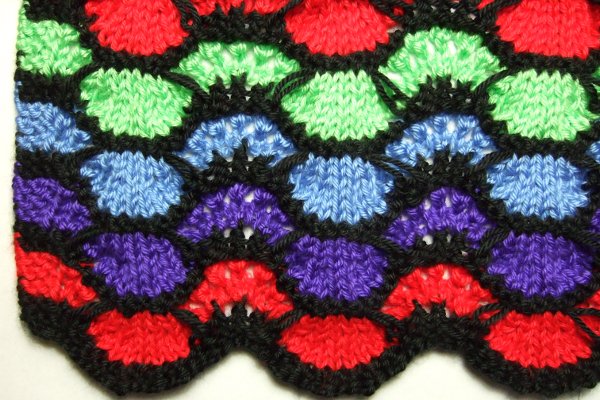
This is a twist on the old standard Feather and Fan.  Slipped stitches provide the strands that are later picked up to form the sides of the windows.

The afghan can be made with most yarns and appropriate needles for yarn.  The example is made with Caron Simply Soft yarn and size 8 (5mm) needles.

Example is a 37 inch square lap blanket, but pattern can be easily modified to make any size.

In the example I used about 7 oz of Black and around 3.5 oz each of Red, Iris, Berry Blue and Limelight.

Any corrections I have discussed in the comments have been incorporated in the pattern.

Techniques:

Slipped stitches – hold yarn in front or back of work as indicated.  Slip the indicated number of stitches by inserting needle to the front, as you would to purl.  It is very important to leave adequate slack in this trailed yarn before working the next stitches.  Accomplish this by fully extending the work in section of dropped stitches.

Picking up trailing yarn strands – on row with stitches indicated pick up the trailing yarn strands by first inserting needle under the trailing strands then through stitch to knit.  Pull knit loop through back below the strands.  The strands will be behind the completed stitch.  Do this for 5 stitches.  The strands will be on the wrong side for the length of these five stitches.

Color:

The effect of the pattern is most striking when using at least two colors.  A primary color forms the frames for the little stained glass pieces.  The sections worked in a secondary color can all be worked in a single color, in a repeat of several colors, or even in different colors  for each section, perhaps from scrap yarn.

Pattern:

Multiple of 18 plus 5.  Change number cast on to change width.

Cast on 167 with primary color.

Rows 1 and 2:  Knit.

Row 3: K3, p2, *with yarn in front, slip 13 purlwise, p5* repeat between * to last 5 stitches, p2, k3.

Row4: K5 *with yarn in back, slip 13 purlwise, k5* repeat between * across.

Row 5: Change to secondary color. K3 *(yo, k1) twice, yo, k2tog three times, k1, k2tog three times, (yo, k1) three times* repeat between * across to last 2 stitches, k2.

Row 6: K3, purl across to last three stitches, k3.

Row 7: Knit.

Row 8: Repeat row 6.

Rows 9 and 10: Repeat rows 5 and 6.

Row 11: Change to primary color. *K9, k5 by inserting needle under the two loose strands before into stitch to knit, k4* across to last 5 stitches, k5.

Row 12: Knit.

Rows 13 and 14: Repeat rows 3 and 4.

Repeat rows 5 to 14 until afghan is desired length.  On last repeat do not work rows 13 and 14.  Cast off while knitting an additional row.

Knitted Carnival Afghan

2 December 2010

This pattern gives the impression of carnival tents. The example is a 32 inch square lapghan, but instructions for given for five sizes, and the pattern can be easily adjusted to make any size desired. Row is a multiple of 18 plus 3 stitches.

This example was made using Caron Simply Soft yarn, an acrylic worsted weight, and size 8 (5mm) needles.

Size: The blanket can be made any size you like. Five sizes are given in the directions.

[grid width=”600″ cols=”100,*,100,*,*”] Size|Width (Inches)|Length (Inches)|Ounces of yarn|Yards of yarn~ Extra Small|32|42.67|17.27|906.5~ Small|35.92|47.89|21.75|1142.09~ Medium|39.84|53.12|26.76|1404.87~ Large|43.76|58.34|32.28|1694.83~ Extra Large|47.67|63.56|38.32|2011.97~[/grid]

Gauge: 18 stitches and 24 rows = 4 inches in stockinette

Materials:
Worsted weight yarn, see chart above for amounts.
Size 8 (5mm) knitting needles

Abbreviations:
k = knit
p = purl
k2tog = knit two together
ssk = slip one knitwise, slip one knitwise, insert left needle into front of both slipped stitches and knit.
S2KP2 – slip2 (together, knitwise), k1, pass 2 slipped stitches over

Instructions:

The number of cast on stitches should be a multiple of 18 plus 3.

Cast on these number of stitches for these widths:
32″ = 147
36″ = 165
39.75″ = 183
43.75″ = 201
47.75″ = 219

Row 1: k3, * yo, k6, S2KP2, k6, yo, k3, repeat from *

Row 2: k3, p1, (p1, k1) 6 times, * p6, (p1, k1) 6 times, repeat from * to last 5 stitches, p2, k3

Row 3: k4, yo, k5, S2KP2, k5, yo, * k5, yo, k5, S2KP2, k5, yo, repeat from * to last 4 stitches, k4

Row 4: k3, p2, (p1, k1) 2 times, p3, (k1, p1) 2 times, * p7, (p1, k1) 2 times, p3, (k1, p1) 2 times, repeat from * to last 5 stitches, p2, k3

Row 5: k3, p2, yo, k4, S2KP2, k4, yo, * p7, yo, k4, S2KP2, k4, yo, repeat from * to last 5 stitches, p2, k3

Row 6: k6,  (p1, k1) 4 times, p1, * k9, (p1, k1) 4 times, p1,  repeat from * to last 6 stitches, k6

Row 7: k3, p3, yo, k3, S2KP2, k3, yo,* p9, yo, k3, S2KP2, k3, yo, repeat from * to last 6 stitches, p3, k3

Row 8: k3, p5, k1, p3, k1, * p13, k1, p3, k1, repeat from * to last 8 stitches, p5, k3

Row 9: k7, yo, k2, S2KP2, k2, yo,* k11, yo, k2, S2KP2, k2, yo, repeat from * to last 7 stitches, k7

Row 10: k3, p6, k1, p1, k1, * p15, k1, p1, k1, repeat from * to last 9 stitches, p6, k3

Row 11: k8, yo, k1, S2KP2, k1, yo,* k13, yo, k1, S2KP2, k1, yo, repeat from * to last 8 stitches, k8

Row 12: k9, p3, * k15, p3 repeat from * to last 9 stitches, k9

Row 13: k3, p6, yo, S2KP2, yo, * p15, yo, S2KP2, yo, repeat from * to last 9 stitches,  p6, k3

Row 14: knit

Continue by repeating these 14 rows until desired length is reached.  Pattern can be made in a single color or color changes can be made between repeats if desired.

On the last repeat, work the 13th row as follows:

Row 13: k9, yo, S2KP2, yo, * k15, yo, S2KP2, yo, repeat from * to last 9 stitches,  k9

Cast off while working row 14.

« Previous Page